Banyan Tree Adventures by Keith Forrester
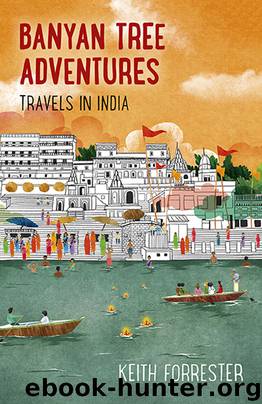
Author:Keith Forrester [Forrester, Keith]
Language: eng
Format: epub
ISBN: 978-1-78535-809-8
Publisher: O-Books
Published: 2018-12-14T05:00:00+00:00
Some good, some bad
When looking at the issue of the British Empire in India, there seems to be a consensus or a dominant narrative of Britain’s time in the country – there were some good aspects and some aspects that were not so good. The Indian Civil Service, which administered the country as a colony from 1858 until 1947, is often cited as a good aspect, for example. Mostly staffed by Englishmen from private schools back in Britain, the Indian Civil Service was described in 1935 by David Lloyd George, a former Prime Minister, as “the steel frame on which the whole structure of our government and of our administration in India rests.” Nehru on the other hand when writing about the Indian Civil Service saw it famously: “as neither Indian, nor civil, nor a service.” Despite this polite difference of opinion, Prime Minister Nehru retained the organisation which today has around 6.5 million employees. The Civil Service after Independence was seen as an important contributor towards developing national unity and cohesion and today continues to be politically modelled on the British example. Overall then, it was a ‘good legacy’ from the British.
A similar story surrounds India’s state-owned rail system. Begun in 1853 with the short link between Bombay to Thane (today, a suburb of Bombay), India has one of the world’s largest networks (115,000 kilometres) with some 7,500 stations. The Bombay to Calcutta line across the northern plains of the country was completed in 1864. The rail system usually is identified as another of the ‘good things’ left to India by the British. Situated within the context of the British Raj and earlier, the East India Company, however, might provide a more nuanced appreciation. Economic and military motives dominated the beginnings of this wonderful system, not passenger or tourist travel.
And then, there is New Delhi. Wandering around Lutyens’ Delhi there remains today a continuing sense of awe and bewilderment. The vast scale of the design, architecture, tree-lined boulevards and grandiose constructions remains breathtaking. Sipping coffee in the commercial centre Connaught Square (and politely fending off the numerous offers of shopping assistance from the locals) begins to reveal the extent of the enterprise but also to raise numerous questions. It was George V, King of England and Emperor of India, who announced at the Delhi Durbar in 1911 that Delhi would replace Calcutta as the new capital of the British Indian Empire; India would be easier to govern from New Delhi rather than the north-east coast of the country. The Raj was on the move. Edwin Lutyens and Herbert Baker were the architects charged with the design of the new imperial centre. Work started after the First World War and was completed in 1931. The splendour of New Delhi continues today to attract attention from visitors around the world and scholars from a variety of disciplines. Connaught Place, the India Gate war memorial, the royal mall Rajpath lined with trees and fountains, and the Secretariat Building are but a few of the sites which are known to a wider global audience.
Download
This site does not store any files on its server. We only index and link to content provided by other sites. Please contact the content providers to delete copyright contents if any and email us, we'll remove relevant links or contents immediately.
The Vikings: Conquering England, France, and Ireland by Wernick Robert(84377)
Ali Pasha, Lion of Ioannina by Eugenia Russell & Eugenia Russell(40317)
The Conquerors (The Winning of America Series Book 3) by Eckert Allan W(37982)
The Vikings: Discoverers of a New World by Wernick Robert(37006)
Cecilia; Or, Memoirs of an Heiress — Volume 1 by Fanny Burney(32636)
Cecilia; Or, Memoirs of an Heiress — Volume 2 by Fanny Burney(32010)
Cecilia; Or, Memoirs of an Heiress — Volume 3 by Fanny Burney(31996)
Empire of the Sikhs by Patwant Singh(23135)
The Secret History by Donna Tartt(19293)
Hans Sturm: A Soldier's Odyssey on the Eastern Front by Gordon Williamson(18649)
Cat's cradle by Kurt Vonnegut(15441)
Pimp by Iceberg Slim(14664)
Sapiens: A Brief History of Humankind by Yuval Noah Harari(14458)
Norse Mythology by Gaiman Neil(13457)
Talking to Strangers by Malcolm Gladwell(13439)
Leonardo da Vinci by Walter Isaacson(13411)
4 3 2 1: A Novel by Paul Auster(12509)
Underground: A Human History of the Worlds Beneath Our Feet by Will Hunt(12144)
The Radium Girls by Kate Moore(12091)
